|
Click thumbs to enlarge. Click- drag to move. Open several.
Parents
Basketmaker - mandenmaker
Van Leeuwenhoek's father, Philips Thoniszoon Leeuwenhoek (the first to
use the surname, without his son's "van"), came from a family of
basketmakers. At the time, baskets were made from readily available
reeds and willow twigs. Like cardboard boxes today, they were used for
a wide variety of purposes where metal or clay containers were too
heavy or rigid.
|
Brewer = brouwer
Van Leeuwenhoek's mother, Margaretha Bel van den Berch, came from a
family of brewers and cloth merchants. On May 16, 1716, van Leeuwenhoek
wrote to Gerard van Loon:
My grand- and great-grandfathers were
brewers, and my grandmother was the daughter of a brewer.
At the time, low-alcohol beers, safer to drink than water, were the
common everyday beverage of everyone, including children, who ate bierenbrood,
bread boiled in beer.
Luyken's image shows the brewer's two biggest
problems: barrels, and clean, fresh water. Both were scarce in Holland,
the water because of textile-industy pollution and sea salt that leaked
into the system of canals. Fresh water had to be imported in special
ships and carefully poured into barrels.
|
Education
Schoolhouse
Adriaen van Ostade
The School Master
Oil on wood, 1662
While nothing remains of the schoolhouses, probably also the teachers'
homes, that van Leeuwenhoek attended, many paintings of the time
suggest that it probably looked something like this.
|
Rozengracht
Van Leeuwenhoek's maternal grandfather was a brewer, as was that
grandfather's father and his wife's (van Leeuwenhoek's grandmother's)
father. Other men in the van der Berch family -- his mother's uncle
Hohan Sabastizennsz and her brother-in-law Pieter Maurits Douchy --
worked in the cloth trade. While van Leeuwenhoek was an apprentice in
Amsterdam from 1648 until 1654, he lived with wool merchant Pieter
Douchy on the Rozengracht.
As is true of most of today's streets with "gracht" at the end of the
street name, the Rosengracht during van Leeuwenhoek's years living
there had a canal running down the middle that, as you can see, was
paved over for car traffic.
|
Neighborhood
Waag
On the right, the city's weigh-house, de Waag. As city wine gauger, van
Leeuwenhoek spent considerable time there. The current building's
facade (not shown here) was added not long after van Leeuwenhoek died.
Used as a weigh-house until 1960, today it is a restaurant whose
interior has retained much of the look and feel of the Dutch Golden Age.
|
Camaretten
The view from van Leeuwenhoek's front door out onto the Camaretten. The
Cameretten ( spelled both ways) is a small open
square over the Voldergracht where it meets the Wijnhaven en
Hippolytusbuurt grachten at the Warmoesbrug right in front of van
Leeuwenhoek's house.
To get to the Stadhuis, van Leeuwenhoek would walk over the bridge,
across the square past the fish market and meat hall on his left, where
he would turn right and be at the back of the Stadhuis.
|
Visbanken and Vleeshal
1650
The visbanken, fish market, is on the left. In his letter of
January 14, 1678 to Robert Hooke, van Leeuwenhoek wrote, "Between the
sea fish market and my house is only a canal." The ancient fish market
across the gracht from van Leeuwenhoek's house specialized in
sea fish, as opposed to the river fish market on the Oude Gracht.
|
Visbanken and Vleeshal
2009
The vleeshal, meat hall, is on the right. This stone building
to replace the repeatedly burned wooden halls for the meat market was
finished in 1650, just before van Leewenhoek moved to the neighborhood.
In 1871, it was renamed the Koornbeurs and is today a national
monument.
The Oude Kerk is in the background. Just over the Warmoesbrug, the
little bridge, van Leeuwenhoek's house, long gone, was the second one
in from the corner.
|
Town Hall
Stadhuis, City Hall, from
the west
In 1660, at age 27, van Leeuwenhoek was appointed Camerbewaarder der
Camer van Heeren Schepenen van Delft, Chamberlain of the
Council-Chamber of the Worshipful Sheriffs of Delft. He was supposed to
take care of the Schepenkamer, the room where the city aldermen met.
The room was in the new Stadhuis, City Hall, built in 1620 less than a
hundred yards from van Leeuwenhoek's house.
Walking from his house, just around the corner past the Camaretten, van
Leeuwenhoek would have come upon the Stadhuis from the west. The Nieuwe
Kerk tower rises across Market Square. The three closest windows on the
second floor look in on the Schepenkamer.
|
Burgerzaal
The view from the Burgerzaal, or Citizen's Hall. On the left is the end
of the judges seat and, up on a landing, the tall double doors to the
Schepenkamer, van Leeuwenhoek's responsibility.
This wide public hall is immediately inside the Stadhuis' front door.
It was used as a meeting place, a waiting place, and on special market
days, a sales place for printed things: books, maps, etc. On the far
wall was Bronckhorst's oil "Judgement of Salomo", and in front of it
the traditional vierschaar, four judges' seat. Twice a week,
it was the place where official business was made public: laws, rents,
and penalties.
|
Schepenkamer
The Schepenkamer, or alderman's room, is off the back right of the
Citizen's Hall. After 1678, its walls were covered with paintings and
maps in richly carved frames with symbolic images and text. The outside
windows have images of the Delft Arms.
According to Dobell's and Haaxman's biographies, van Leeuwenhoek's
appointment provided a sinecure of 314 florins per year: 260 for acting
as Chamberlain, and 54 florins to actually do the work, which would
have been done by someone van Leeuwenhoek hired. He held post until
1699, and continued to draw the salary, increased to 400 florins, until
his death.
The extract from the town records appointing van Leeuwenhoek lists his
responsibilities (Dobell translation):
"to open and to shut the Chamber at both ordinary and extraordinary
assemblies of the Gentlemen
"to show towards these Gentlemen all respect, honour and reverence and
diligently to perform and fathfully to execute all charges which may be
laid upon him and to keep to himself whatever he may overhear in the
Chamber
"to clean the foresaid Chamber properly and to keep it neat and tidy
"to lay the fire at such times as it may be required and ...
"carefully to presenrve for his own profit what coals may remain
unconsumed and see to it that no mischance befall thereby nor from the
light of the candles"
|
Memorial
On the wall just outside the Schepenkamer is now a small case
commemorating van Leeuwenhoek, containing a replica of one of his
little but powerful microscopes.
|
Influences
William Davidson
William Davidson, a wealthy Scottish cloth merchant, settled in
Amsterdam and married a Dutch woman. Through espionage, he actively
supported the exiled Charles II. Restored to the throne, Charles II
knighted Davidson and appointed him Conservator of the Staple at Veere,
to protect Scottish trading privileges.
This portrait [detailed here] of Sir William with his son Charles was
painted by Abraham Lambertsz van den Tempel around 1664, ten years
after van Leeuwenhoek returned to Delft.
|
Constantijn and
Christiaan Huygens
Statue of Christiaan Huygens outside the Knowledge Centre of
the Faculty of Electrical Engineering, Mathematics and Computer
Science, Technical University, Delft
Inset of his father, Constantijn Huygens
Father and son, they were a prominent Dutch family in the Golden Age,
corresponding with and visiting van Leeuwenhoek. Constantijn
(1596–1687) was a poet and composer and one of the most influential
intellectuals of the Golden Age.
His son Christiaan (1629–1695) was a scientist, astronomer, and
inventor. He was one of the first (1663) foreign members of England's
Royal Society and was an influential member of the French Academy of
Sciences. At first, he was dubious about van Leeuwenhoek's claims.
Christiaan represented van Leeuwenhoek's work to the French through the
French Academy of Sciences. They published in the Journal de
Scavans many extracts from the letters in Philosophical
Transactions, translated from English (after having already been
translated from Dutch).
|
Mentors
Regnier de Graaf
Regnier de Graaf (1641-1673) a physician lived the last ten years of
his short life in Delft, where he performed radical, groundbreaking
research into human reproduction. He did not use a microscope, but he
was the first to develop a syringe to inject dye into human
reproductive organs so that he could understand their structure and
function.
He had been published in Philosophical Transactions in volume
4, 1669. Just weeks before he died, de Graaf sent his editor, Henry
Oldenburg, a cover letter introducing van Leeuwenhoek addressed to the
Royal Society.
A certain most ingenious person here, named
Leewenhoeck, has devised microscopes which far surpass those which we
have hitherto seen, manufactured by Eustachio Divini and others. The
enclosed letter from him, wherein he describes certain things which he
has ovserved more accurately than previous authors, will afford you a
sample of his work; and if it please you, and you would test the skill
of this most diligent man and give him encouragement, then pray send hm
a letter containng your suggestions, and proposing to him more
difficult problems of the same kind.
Olderburg did exactly as de Graaf suggested.
|
Hooke and Oldenburg
One of the lessons from Francis Bacon that the radical philosophers of
the Royal Society insisted on was the repeatability of experiments.
When van Leeuwenhoek started sending his letters to the Royal Society,
Henry Oldenburg (1619-1677) was its secretary and Robert Hooke (1635 -
1703) was its curator of experiments.
Oldenburg (inset) solicited van Leeuwenhoek's letters, and until he
died in 1677, he encouraged van Leeuwenhoek and suggested further
topics for his microscopic investigations.
Hooke (of whom there is no portrait) tried to repeat van Leeuwenhoek's
experiment in front of the other Fellows of the Society, assembled in
London. The first attempt did not meet their standards, so a week
later, on November 15, 1677, Hooke tried again. Everyone was able to
see "great numbers of exceedingly small animals swimming to and fro."
The Royal Society's motto was in Latin: Nullius in Verba (On the words
of no one). Even though van Leeuwenhoek had sent them over a dozen
letters for several years, all of which proved reliable, the Fellows
wouldn't accept van Leeuwenhoek's claim on his word alone. He claimed
to have seen animals so small that they had never before been seen by
any human being, animals whose existence was not even suspected. The
Fellows had to see the tiny creatures for themselves.
Birch's History of the Royal Society (1756) continues:
They were observed to have all manner of
motions to and fro in the water; and by all, who saw them, they were
verily believed to be animals; and that there could be no fallacy in
the appearance. ... So that there was no longer any doubt of Mr.
Leeuwenhoeck's discoveries.
|
Learn more
See more images on the Maps page.
Wikipedia entries for:
Delft en | nl
Dutch Republic en
| nl
Regnier de Graaf en
| nl
Royal
Society
Vermeer en
| nl
|
The Curious Observer
The early life of Antony van Leeuwenhoek,
cloth merchant and haberdasher,
citizen of Delft.
Four hundred years ago, during the 1600's, the Dutch Republic
was a soggy, overcrowded little country. A natural wetland, it had few
resources other than peat and water, no forests, no mineral deposits.
It did not have enough fertile farmland to feed the people born there
let alone the immigrants pouring in from less tolerant countries.
Yet the Republic of the Seven United Provinces was quickly
becoming
the most prosperous and most learned country in Europe.
When Antony van Leeuwenhoek was born in 1632, the Republic had
about 1.75 million people, a tenth of what is has today. The province
of Holland had about forty percent of them, a third of whom lived not
on farms but in the
five largest cities.
In 1632, Delft, in the southern part of the country, was the
fourth largest city, fueled by foreign trade as one of the six VOC
cities. It was filling with foreigners, who brought their skills,
labor, and capital to manufacturing and crafts: textiles, ship and
building construction, ceramics, and beer.
| Population
- 1622 |
| Amsterdam |
105,000
|
| Leiden |
45,000
|
| Haarlem |
40,000
|
| Delft |
22,000
|
Rotterdam
|
20,000
|
| Dordrecht |
18,000
|
The Hague
|
16,000
|
|
| Paris |
~400,000
|
| London |
~400,000
|
| including the surrounding villages.
source: De Vries and Van Der Woude |
|
In the fall of 1632, two people were born in Delft who had the
liberty to pursue their visions. Jan Vermeer and Antony van
Leeuwenhoek, both born into Nederduits Gereformeerde Kerk (Dutch
Reformed Church) families, were baptized in the Nieuwe Kerk (New
Church) just four days apart. Vermeer's visions gave us a pictorial
record of life as it was lived then. Unfortunately, Vermeer died at 43.
One of the executors of his tangled estate was van Leeuwenhoek, who
while Vermeer painted established himself as a retail cloth merchant
and minor city official. His scientific career was starting just about
the time Vermeer died.
Because of the worldwide market for all things Vermeer, we
have many vivid and illustrated histories of van Leeuwenhoek's Delft
based on quite a bit of documentary evidence. Unfortunately, very
little of it involves van Leeuwenhoek by name. In the absence of direct
evidence, conjecture has been repeated until a patina of plausible but
unsubstantiated details has fleshed out the frustratingly few facts
about van Leeuwenhoek's life and work.
Though we can infer much about his character from the several
hundred letters that he wrote over fifty years, here are some of the
documented events during the first half of van Leeuwenhoek's life.
| 1632 |
Born in Delft. His father Philips is a basket maker. His
mother comes from a family of brewers. He has four surviving sisters.
|
| 1638 |
Father dies.
|
| 1640 |
Mother marries Jacob Molijn, a painter. Antony is sent
to school in nearby villages Warmond and then Benthuizen.
|
| 1648 |
Apprentices at 16 in Amsterdam to Scottish linen draper
William Davidson.
|
| 1654 |
Settles at 22 in Delft and marries Barbara de Meij. With
5,000 borrowed florins, buys the house and shop, Het Gouden Hoofd, the
Golden Head, from Johan Lieftingh, an apothecary, apoteeker.
|
| 1655 |
Pays his entry fee, incomste,
to the Sint Nicolaas Gilde, and yearly thereafter pays his dues. |
| 1660 |
Appointed city chamberlain, camerbewaarder.
|
| 1666 |
Wife Barbara dies. Of their five children, only Maria
survives infancy.
|
| 1668 |
Travels to England and uses a lens to examine the chalky
cliffs to learn why they are white.
|
| 1669 |
Certified as a surveyor, landmeter, after
passing the oral examination.
|
| 1671 |
Marries Cornelia Swalmius. They have no children.
|
| 1673 |
Under a cover letter of introduction by Delft physician
Regnier de Graaf, sends his first letter to Henry Oldenburg, secretary
of England's Royal Society and editor of its journal, Philosophical
Transactions. The letter repeats and extends the microscopic
observations of the Society's curator of experiments, Robert Hooke.
|
|
1673
-
1677
|
With hand-made lenses and microscopes, makes the
observations that, in retrospect, we see as the most significant:
protozoa, bacteria, red blood cells, and sperm.
|
| 1676 |
Appointed an executor of the painter Jan Vermeer's
estate.
|
| 1679 |
Elected city wine gauger, wijnroeier.
|
| 1680 |
After seven years and a dozen letters published in their
peer-reviewed journal, the Royal Society elects him a Fellow.
|
Constantijn Huygens wrote to Robert Hooke on August 8, 1673,
that van Leeuwenhoek was:
... a modest man, unlearned both in sciences and
languages, but of his own nature exceedingly curious and industrious
... always modestly submitting his experiences and conceits about them
to the censure and correction of the learned.
That was only the beginning. For the next half century, until
his death in 1723, Antony van Leeuwenhoek made little microscopes,
hundreds of them, and closely observed the world around him. What the
Dutch Republic lacked in physical resources it made up for by
developing its intellectual capital.
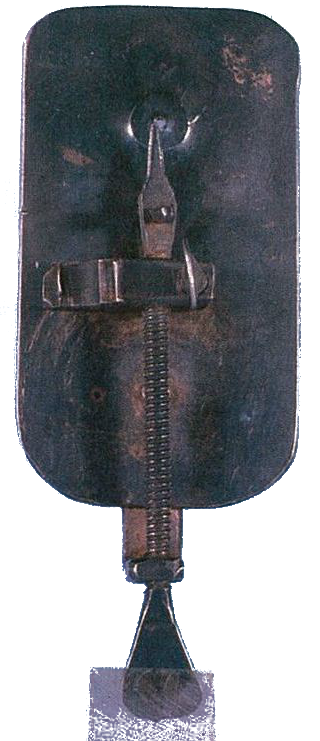
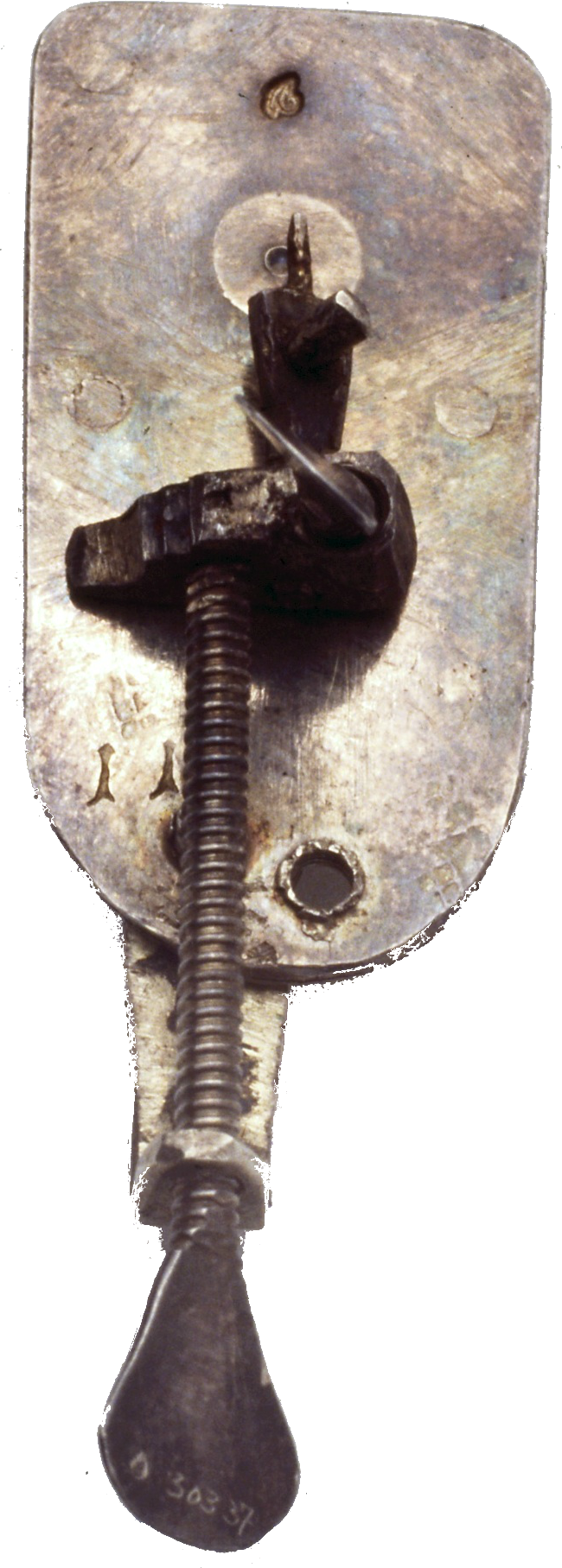
How did van Leeuwenhoek make these microscopes? What did he
see through their tiny lenses?
|
Sources of income
In addition to his linen drapery and
haberdashery business, other sources of income let van Leeuwenhoek
pursue his microscopic observations.
According to the article on the van
Leeuwenhoek family genealogy by E.W. van den Burg and G.J. Leeuwenhoek,
these minor civic appointments brought van Leeuwenhoek 800 guilders
yearly.
surveyor
landmeter
surveyor (landmeter)
The instruments were not perfect, but they were good enough for the
legal system at the time.
In 1669, van Leeuwenhoek passed an oral examination by mathematician
Genesis Baen in the "art of Geometry".
|
surveyor (landmeter)
Ih his letters, van Leeuwenhoek used these spatial mathematics skills
to confidently calculate sizes, volumes, heights, and numbers. See the
Counting page of this web.
|
Because they both measured things, it
was common for a landmeter or surveyor to also be a wijnroeier.
city wine gauger
wijnroeier
wijnroeier (wijngauger)
An important source of income for the city of Delft was excise taxes on
imported goods. For some goods, it was just a matter of weighing them
at the Waag. For other goods, specifically liquid in barrels, this was
more complicated because barrels were not standardized and for the
liquid, the quality could be more important than the quantity.
The wine gauger was responsible not only for wine, but also for
spirits, fats and other liquids imported in barrels. The mathematics
they used for measuring volume were not difficult, but the
computational skills were not common, either.
In 1679, van Leeuwenhoek was elected to this important position, and
held it for the rest of his life.
|
Vermeer Connection
A lot of circumstantial, even common
sense evidence links Vermeer and van Leeuwenhoek.
However, no direct documentary evidence connects between except van
Leeuwenhoek's service as an executor of Vermeer's estate.
Every other connection has at least one degree of separation.
But Delft was a small town. Van
Leeuwenhoek and Vermeer lived very close to each other. Van Leeuwenhoek
sold linen material; Vermeer painted on linen.
They had many common friends, especially in the St. Luke's Guild of
painters, and they had common interests, such as optics.
Children
Van Leeuwenhoek's first wife Barbara
bore five children.
1655 - Philips Thonisz.
died in infancy.
1656 - Maria Thonisdr.
lived until 1745.
1658 - Margriete Thonisdr.
died in infancy.
1663 - Philips Thonisz.
died in infancy.
1664 - Philips Thonisz.
lived less than two years. Barbara died three weeks after he did in the
summer of 1666.
|